var_threshold🔗
Short description🔗
var_threshold — Threshold an image by local mean and standard deviation analysis.
Signature🔗
var_threshold( image Image, out region Region, extent.x MaskWidth, extent.y MaskHeight, number StdDevScale, number AbsThreshold, string LightDark )
Description🔗
With var_threshold, it’s possible to select the pixels of the input
Image which
- have a high local standard deviation (for a positive
StdDevScale), or a low local standard deviation (for a negativeStdDevScale)
and
- are locally bright or dark, according to
LightDark.
Thus, it is possible to segment regions on inhomogeneous, noisy, or unevenly illuminated backgrounds.
Hints for the input parameters🔗
-
MaskWidth,MaskHeightThe size of the filter mask defined byMaskWidthandMaskHeightdetermines the maximum size of the objects to be segmented. However, if the mask is chosen too large, objects that are very close might be merged.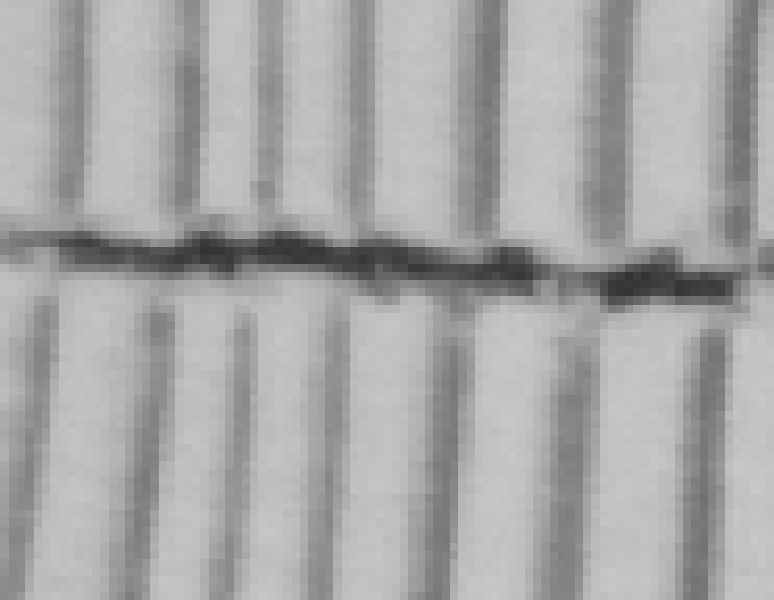
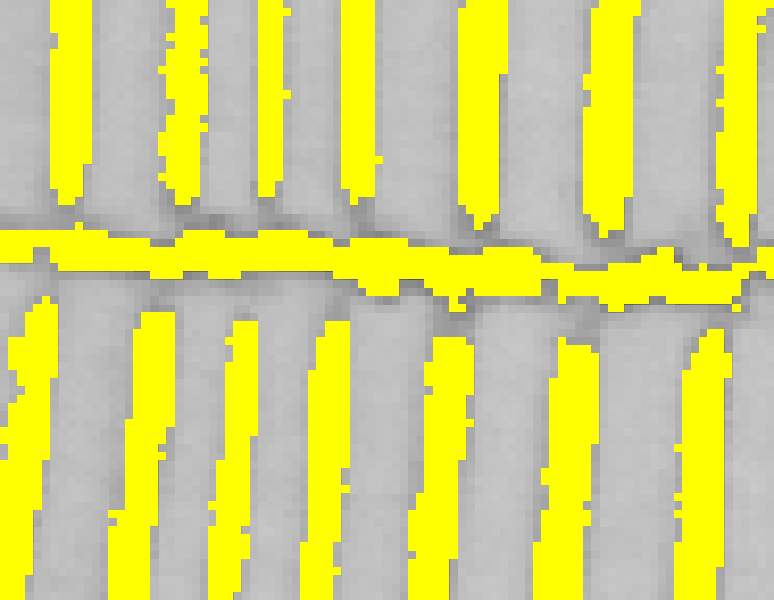
(1) (2) 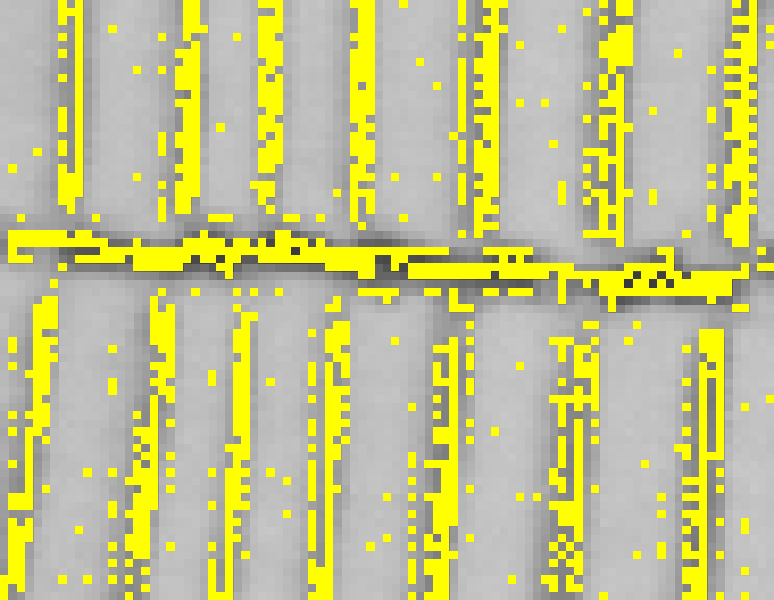
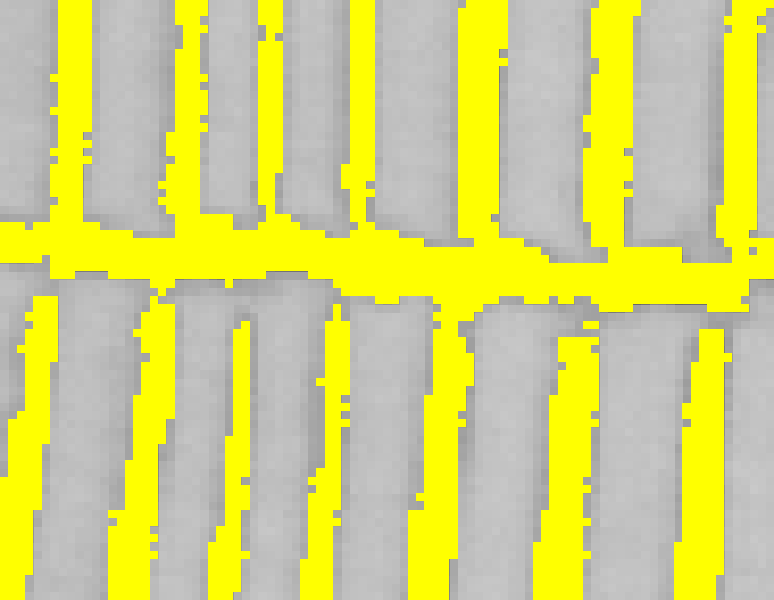
(3) (4) (1) Original image; the goal is to count the vertical lines. (2)
MaskWidth:= 12,MaskHeight:= 12,StdDevScale:= 0.1, all vertical lines are segmented correctly. (3) If the mask size is chosen too low (3), the desired regions are not selected properly. (4) If the mask size is too high (40), objects that are very close might be merged.If
MaskWidthorMaskHeightis even, the next larger odd value is used. Altogether, a value of 3 can be considered the minimum sensible value. -
The local standard deviation is used as a measure of noise in the image. It can be scaled by
StdDevScaleto reflect the desired sensitivity. A higher value means that only pixels that are very different from their surrounding are selected.For the parameter
StdDevScalevalues between \(-1.0\) and \(1.0\) are sensible choices, with \(0.2\) as a suggested value. If the parameter is too high or too low, an empty or full region may be returned.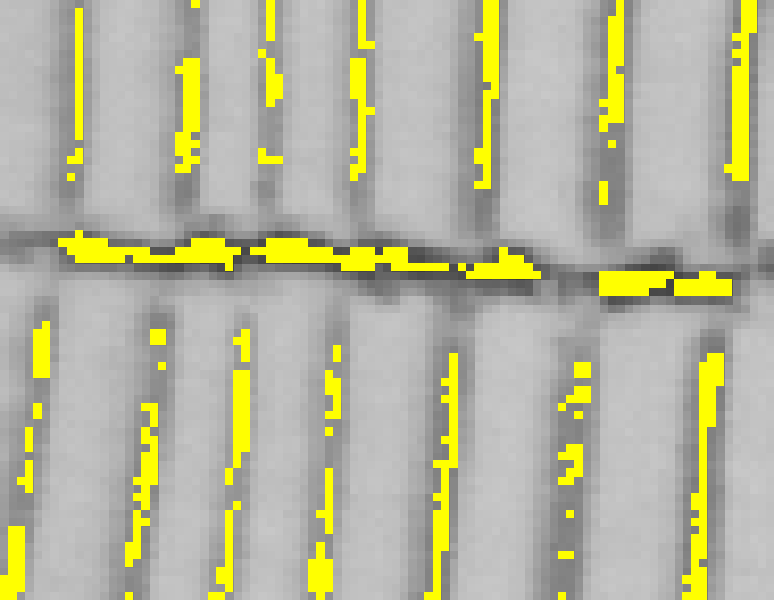
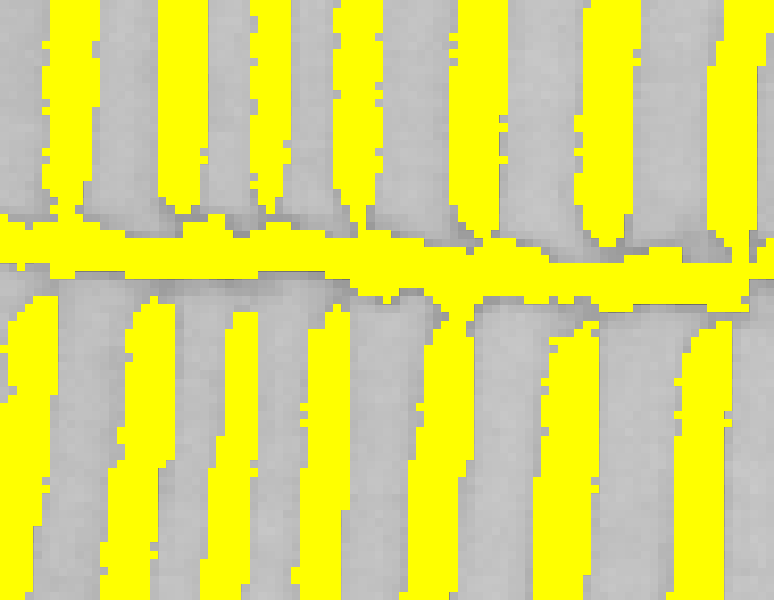
(1) (2) (1) If
StdDevScaleis too high (1.3), the operator is ‘picky’; only pixels that are very similar to their surrounding are selected. (2) IfStdDevScaleis too low (-0.3), too many pixels that are somewhat similar to their surrounding are incorrectly selected. -
In homogeneous areas of an image, the standard deviation is low; thus, the influence of single gray values is high. To reduce the sensitivity of the operator in homogeneous areas, it’s possible to adjust
AbsThreshold. Thus, small gray value changes in homogeneous surroundings can be ignored. Note that for negative values ofStdDevScale,AbsThresholdshould also be chosen negative. -
'light' or 'dark' returns all pixels that are lighter or darker than their surrounding, respectively. 'equal' returns all pixels that are not selected by either option, i.e. the pixels that are relatively equal to their surrounding. 'not_equal' returns the combined results of 'light' and 'dark', i.e., all pixels that differ from their surrounding.
The calculation🔗
 |
 |
| (1) | (2) |
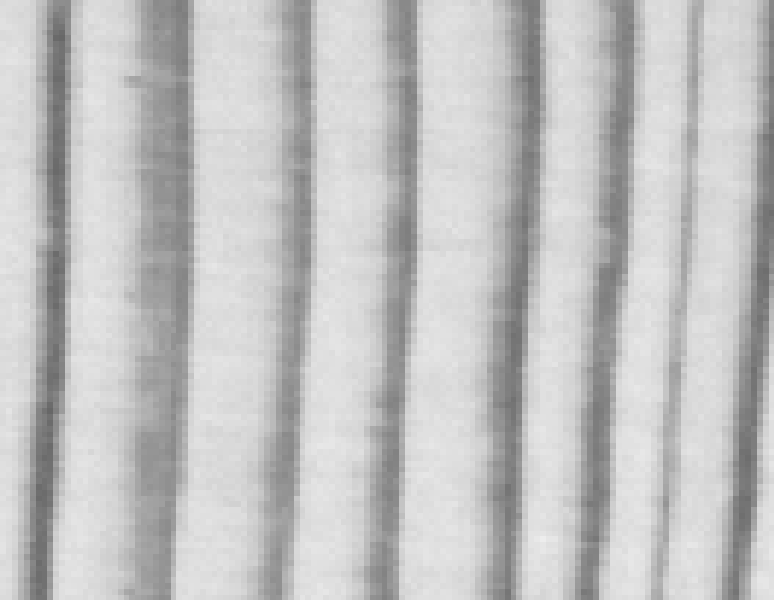
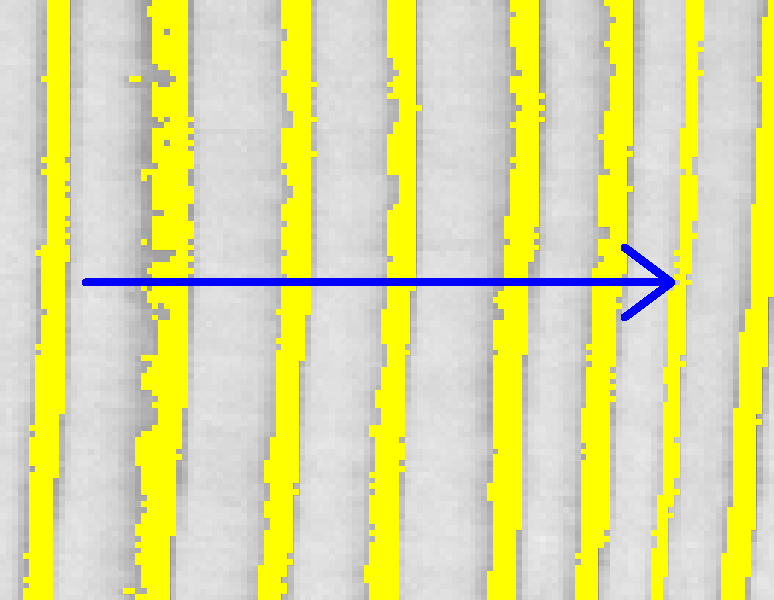
(1) Initial image. (2) Thresholded image (StdDevScale :=
0.6, MaskWidth := 15, MaskHeight :=
15, AbsThreshold := 10). The following
images visualize exemplary how the result along the blue arrow came to be.
var_threshold selects from the input image
Image those regions Region in which the pixels
fulfill a threshold condition. The threshold is calculated from the
mean gray value and the standard deviation in a local mask of size
MaskWidth x MaskHeight around each pixel
\((x,y)\).
Let
-
\(g(x,y)\) be the gray value at position \((x,y)\) in the input
Image, -
\(m(x,y)\) the corresponding mean gray value, and
-
\(d(x,y)\) the corresponding standard deviation in the mask around that pixel.
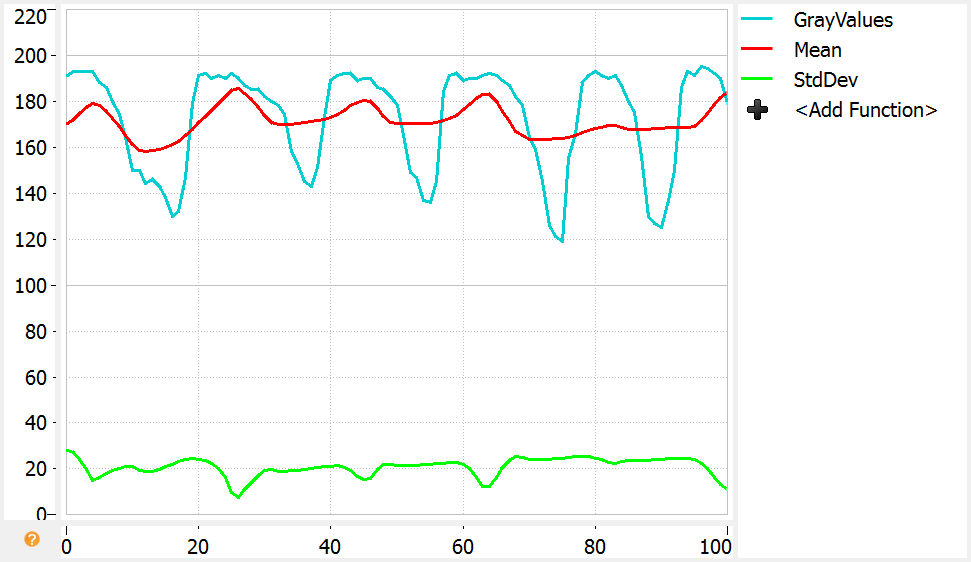
The original gray values, the corresponding mean gray values, and the corresponding standard deviation in the mask around these pixels.
Then, the variable threshold \(v(x,y)\) is defined as
\(v(x,y) = max( \textrm{StdDevScale} * d(x,y),\textrm{AbsThreshold})\) for \(\textrm{StdDevScale} \ge 0\) or \(v(x,y) = min( \textrm{StdDevScale} * d(x,y), \textrm{AbsThreshold})\) for \(\textrm{StdDevScale} < 0\).
Interpretation: For a positive StdDevScale, each pixel is analyzed.
It is determined whether the user-defined AbsThreshold or the
scaled standard deviation is greater. The bigger value is chosen as variable
threshold \(v(x,y)\). For a negative StdDevScale, the corresponding
smaller value is chosen.
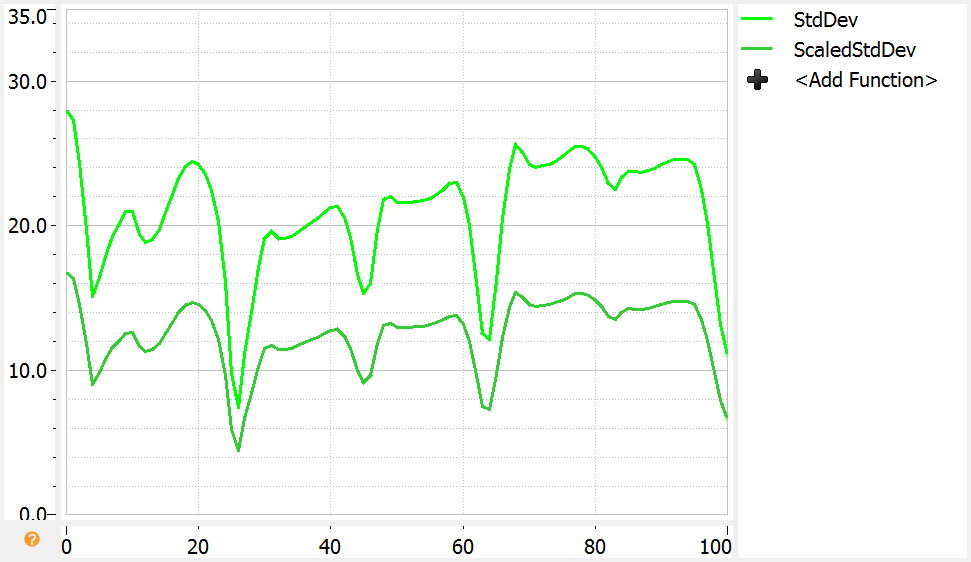
The standard deviation can be scaled with StdDevScale.
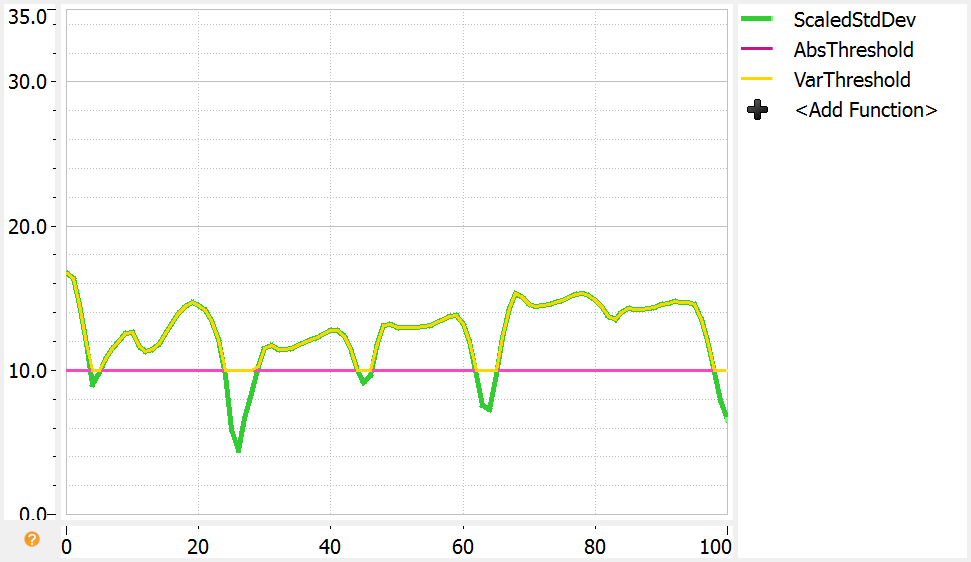
The variable threshold is chosen based on the scaled standard deviation
and AbsThreshold.
Which pixels are chosen based on the variable threshold is defined by
the parameter LightDark:
-
'light': \(g(x,y) \ge m(x,y) + v(x,y)\).
Interpretation: If the pixel is brighter by \(v(x,y)\) than its surrounding, it is selected.
-
'dark': \(g(x,y) \le m(x,y) - v(x,y)\).
Interpretation: If the pixel is darker by \(v(x,y)\) than its surrounding, it is selected.
LightDark= 'equal': \(m(x,y) - v(x,y) \le g(x,y) \le m(x,y) + v(x,y)\).Interpretation: Select exactly those pixels that are not selected by 'light' and 'dark', i.e., the pixels that are relatively equal to their surrounding.
-
'not_equal': \(m(x,y) - v(x,y) > g(x,y) \quad \lor \quad g(x,y) > m(x,y) + v(x,y)\).
Interpretation: Select all pixels of 'light' and 'dark', i.e., all pixels that differ by \(v(x,y)\) from their surrounding.
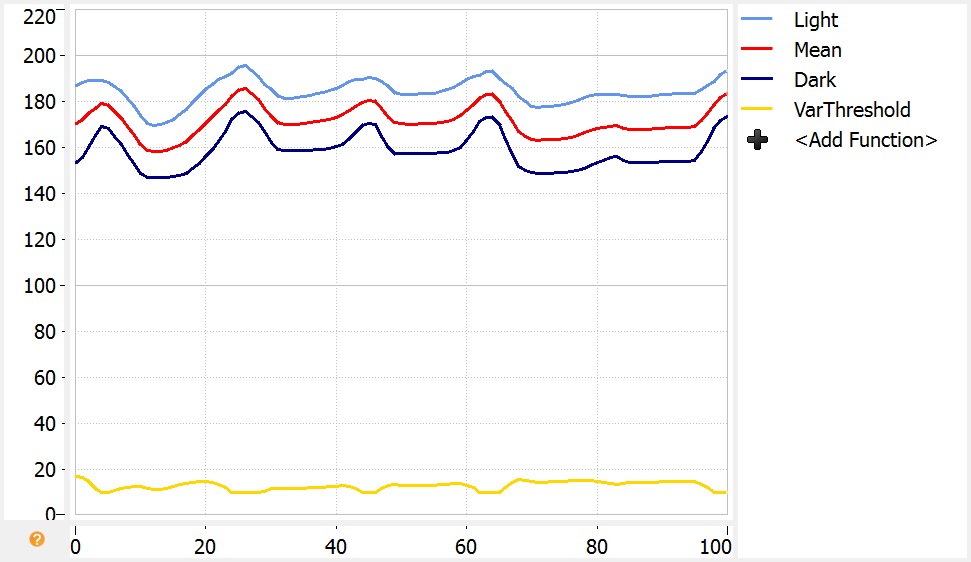
'light' and 'dark' are calculated based on the corresponding mean gray value and the variable threshold.
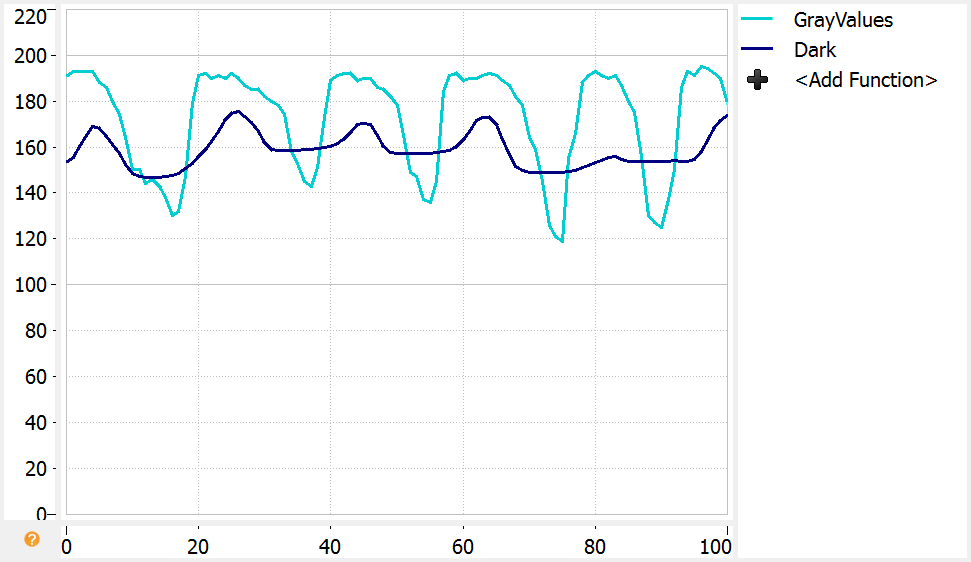
For example, if 'dark' is selected, all pixels where the ‘Dark’ curve is above the ‘GrayValues’ curve would be selected.
Attention🔗
Note that filter operators may return unexpected results if an image with a reduced domain is used as input. Please refer to the chapter Filters.
Execution information🔗
Execution information
-
Multithreading type: reentrant (runs in parallel with non-exclusive operators).
-
Multithreading scope: global (may be called from any thread).
-
Automatically parallelized on tuple level.
-
Automatically parallelized on domain level.
Parameters🔗
Image (input_object) singlechannelimage(-array) → object (byte / int2 / int4 / uint2 / real)
Input image.
Region (output_object) region(-array) → object
Segmented regions.
MaskWidth (input_control) extent.x → (integer)
Mask width for mean and deviation calculation.
Default: 15
Suggested values: 9, 11, 13, 15
Restriction: MaskWidth>=1
MaskHeight (input_control) extent.y → (integer)
Mask height for mean and deviation calculation.
Default: 15
Suggested values: 9, 11, 13, 15
Restriction: MaskHeight>=1
StdDevScale (input_control) number → (real / integer)
Factor for the standard deviation of the gray values.
Default: 0.2
Suggested values: -0.2, -0.1, 0.1, 0.2
AbsThreshold (input_control) number → (real / integer)
Minimum gray value difference from the mean.
Default: 2
Suggested values: -2, -1, 0, 1, 2
LightDark (input_control) string → (string)
Threshold type.
Default: 'dark'
List of values: 'dark', 'equal', 'light', 'not_equal'
Complexity🔗
Let \(A\) be the area of the input region, then the runtime is \(O(A)\).
Result🔗
var_threshold returns 2 (H_MSG_TRUE) if all parameters are correct.
The behavior with respect to the input images and output regions can
be determined by setting the values of the flags 'no_object_result',
'empty_region_result', and 'store_empty_region' with
set_system. If necessary, an exception is raised.
Combinations with other operators🔗
References🔗
W.Niblack, ‘’An Introduction to Digital Image Processing’‘, Page 115-116, Englewood Cliffs, N.J., Prentice Hall, 1986
Module🔗
Foundation