PDF417 grades🔗
Overall symbol grade🔗
The overall symbol grade is calculated for all symbol types that are supported by HALCON, except for DotCode symbols,
and is always the first element in the tuple of quality grades returned by get_data_code_2d_results. The
overall symbol grade is the lowest quality grade obtained for the complete set of features that are evaluated for the
selected type of 2D data code. If, e.g., for one of the features the value '0.0' is returned, the overall symbol grade is graded
with the value '0.0' even if all other features have the value '4.0'.
Modulation🔗
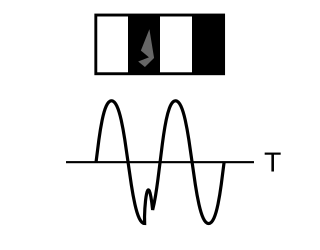
The modulation is evaluated for symbols of type Data Matrix ECC 200, QR Code, Micro QR Code, or Aztec Code as well as for symbols of type PDF417. It measures the uniformity of reflectance of the dark and light modules inside the symbol and therefore how good the modules can be distinguished into dark and light. Further, the correct classification states of the modules as well as the error correction capacity of the symbol are taken into account. If the modulation is low, the probability that modules are not correctly classified as dark or light modules increases.

The figure above shows three symbols with different modulations. The first one consists only of black and white modules.
It is clear which modules belong to the dark modules and which belong to the light modules, so the modulation
is graded with the value 4.0. For the other symbols, the contrast for a local part of the symbol changes so that one
part of the symbol consists of black and white modules and another part consists of gray and white modules. In
the second symbol the gray values of the black and gray modules differ only slightly and thus, the gray modules
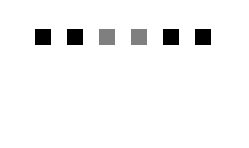
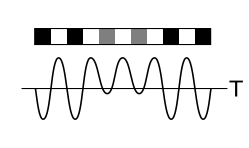
still have a good chance to be identified correctly and the quality is graded with value 2.2. For the third symbol, the
gray modules have a gray value that is somewhere in between black and white, i.e., their amplitude is rather low
(see below).
A reliable identification of the modules is difficult and the quality of the modulation is graded with the value 0.1.
Unused error correction🔗
The quality grade for unused error correction quantifies the reserve in error correction that is still available after
reading the data code. A perfect data code requires no error correction at all, resulting in a quality grade of value
4.0 (
).
The more defective a data code becomes, the more the inherent error correction needs to be
applied to still be able to read the data code.
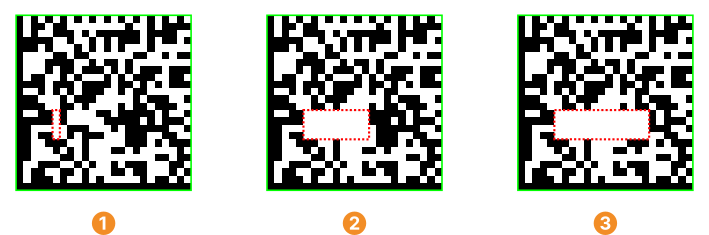
shows two symbols (
and
) for which degradations occur
inside the data patterns. Dependent on the amount of the degradations, the values for the quality grade decrease to
2.4 and 0.2.
Start/Stop pattern🔗
The quality grade for the start/stop pattern of a symbol of type PDF417 evaluates the quality of the reflectance profile as well as the correctness of the sequence of the light and dark bars for the start and stop patterns.
Codeword yield🔗
The quality grade for the codeword yield evaluates how many of the attempts to read the individual codewords were successful.
Decodability🔗
The quality grade for the decodability describes to which amount the light and dark bars are metrically correct, i.e., it measures the deviations between the actual widths of the bars from the theoretical widths that can be derived from the size of the symbol and the known number of bars (17) per codeword.
Defects🔗
The quality grade for defects describes the amount of radiometric degradations inside the individual modules or the quiet zone, i.e., dark spots inside the light modules, the light parts of the finder pattern, or the quiet zone, and light spots inside the dark modules or the dark parts of the finder pattern (see figure below).