Inspecting or reconstructing 3D surfaces with structured light🔗
The basic concept behind structured light is to use a structured illumination, that is, an illumination showing well-known patterns. The way those patterns appear in the scene after hitting surfaces helps to further analyze (for example, perform an inspection) or reconstruct the surfaces.
Deflectometry is the procedure of analyzing the reflections of known patterns from specular or semi-specular surfaces. In such a setup, every pattern image must be shown by the display or monitor. It is then reflected by the specular surface under test, and a camera image of the reflection is acquired. Deformations of the pattern in the camera image are caused by the form of the specular surface, which implies that defects on the specular surface can be detected.
For non-specular (lambertian or diffuse) surfaces, a 3D surface can be reconstructed using a projector projecting light like an “inverse camera”.
For every projected pattern image, a camera image of the projection on the surface is acquired.
Using the decoded correspondence between projector coordinates lighting the camera coordinates, as well as calibration information, the 3D surface is reconstructed.
Structured light setups🔗
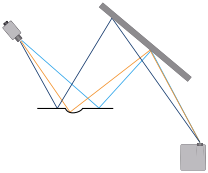
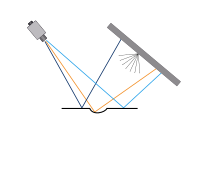
For deflectometry applications structured light patterns are projected onto the surface by a projector and a diffusor plate ( ) or a monitor ( ). Note, in parts not specific to a pattern source both, monitor and projector with diffusor plate, are meant even if only one of them is mentioned. The specular or partially specular surface reflects the pattern, which is then captured by a camera.
In case of using a projector as a pattern source for deflectometry, a diffuse emitting surface is required for generating a flat grid. Also, it is not suitable to point the projector directly onto the surface as the projector has a divergent beam. Compared to monitors, projectors will potentially offer a higher brightness, which is a key advantage for the inspection of partially specular surfaces. Furthermore, depending on the technology they rely on, some projectors provide a high frame rate, thus enabling the implementation of short inspection cycles.
Surface defects like dents deflect the light in such a way that monitor pixels which are far from each other appear closer to each other in the reflected pattern and thus, in the captured camera image. Each camera pixel ‘sees’ a specific monitor pixel. The purpose of deflectometry is to detect which camera pixel ‘sees’ which monitor pixel and to analyze these correspondences to find defects.
| Camera setup with projector and diffusor | Camera setup with monitor | Camera setup with projector |
|---|---|---|
 |
 |
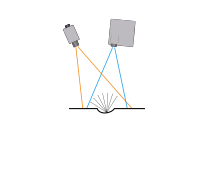 |
For 3D reconstruction applications light patterns are directly projected onto the surface by a projector ( ). As the object surface needs to be diffuse, light is not deflected but scattered. With the calibration data of the camera and the projector, which is interpreted as an ‘inverse’ camera, the points of the object surface are reconstructed. Thereby, the angle between the camera and the projector’s line of sight should neither be too acute nor extremely obtuse.