Continual Learning🔗
Continual Learning for classification is a machine learning approach where a model learns from new data over time without forgetting previously acquired knowledge.
New classes can be added, or existing classes can be expanded iteratively with additional data without requiring the training data of previous training steps.
In contrast, standard classification (see DL classification) requires retraining on both old and new training data together.
With Continual Learning, the model can thus be adapted to new requirements much quicker. A Continual Learning model can even be extended with new data if it is optimized for an AI² interface. This enables models to be trained and deployed directly on an edge device.
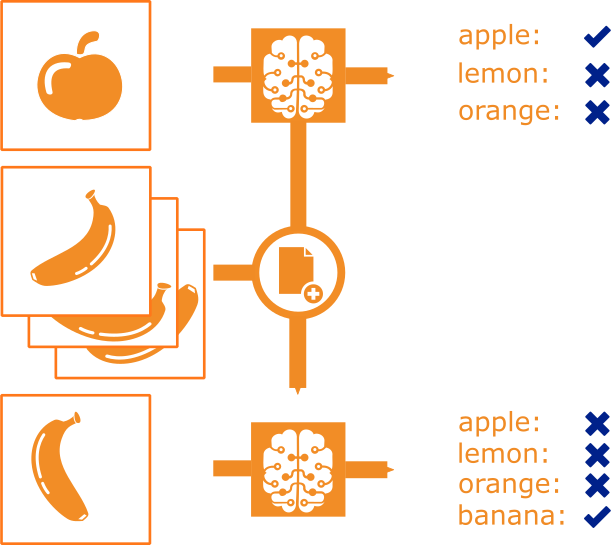
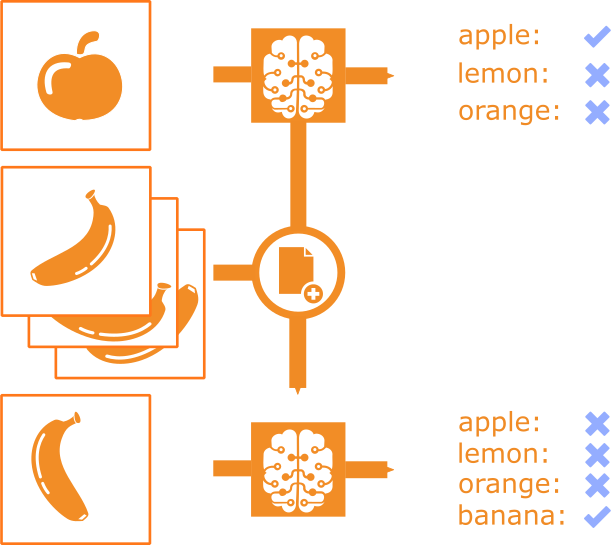
Figure 1. A possible Continual Learning for classification example, in which the network was originally trained to distinguish three classes. Later, the model was extended with an additional class “banana”, using only newly provided banana images, while retaining knowledge of the previously learned classes. According to the top prediction, the image is recognized as “banana”.
Out-of-Distribution Detection for classification is automatically integrated into the Continual Learning workflow.
Unlike standard classification, there is no need to explicitly fit the model with an additional operator.
The necessary calculations for Out-of-Distribution Detection are already included in the Continual Learning operators init_dl_continual_learning and extend_dl_continual_learning.
For more information about Out-of-Distribution Detection, see DL classification.
To classify your data into the classes you want to have distinguished, the starting point is either a model that has already been trained on your dataset or a pretrained classifier provided by HALCON. The model is then initialized for Continual Learning and can be extended multiple times with new data. Such new data may consist of additional classes or further samples for existing classes. For more information about data requirements, see About data below.
More Info
- In HALCON, classification with deep learning is implemented within the more general deep learning model. For more information about the latter, see Deep learning > HALCON DL model.
- For the specific system requirements to apply deep learning, see Requirements for deep learning and deep-learning-based methods.
About data🔗
The data requirements for Continual Learning for classification are similar to standard classification, but with the following key difference: Only the new data needs to be provided during each extension step. Old training data must not be included again.
As a basic concept, the model handles data over dictionaries, meaning it receives the input data over a dictionary DLSample and returns the dictionaries DLResult and DLTrainResult.
For more information about data handling, see Deep learning > HALCON DL model.
For more information about images, network outputs, and the interpretation of results, see DL classification.