Texture analysis🔗
The concept of texture analysis is based on the use of an object’s structural features. In order to thoroughly understand the suitable application of texture analysis, it is important to first comprehend texture itself. Texture designates the structural characteristics of a surface which present themselves as gray value variations in an image. The regularity of a texture varies from absolutely regular to irregular. The basis of a regular texture is an ideal grid structure whereas irregular textures or statistical structures are based upon a random function.
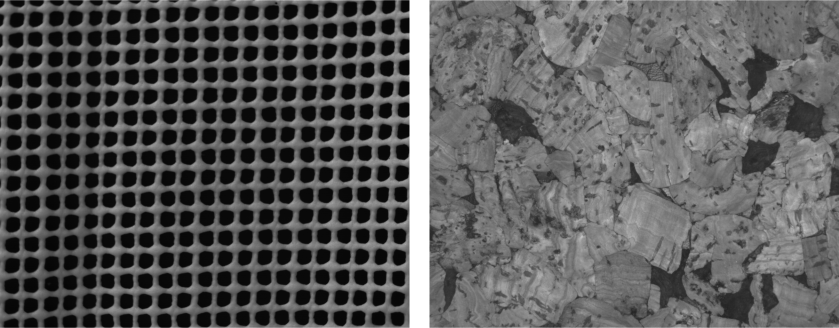
Textures are composed of so-called texels, a short form for texture elements, which can easily be recognized in a regular texture. Irregular textures also have recurring elements, which are, however, more difficult to recognize. When working with irregular textures the measures of a texel have to be approximated if necessary. A texel is the smallest recurring structure as depicted in Figure 2.
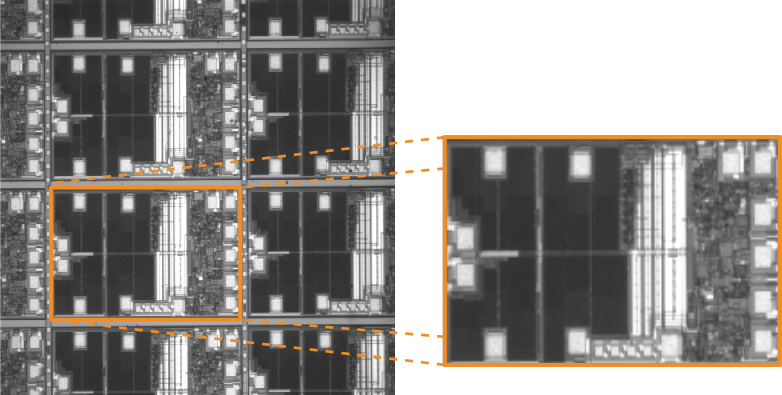
Texture analysis is a very useful method for all tasks which cannot simply be solved as their gray value structure is too complex. It can help you to solve two tasks:
- Where is a certain texture located?
- What kind of texture is it?
The first task is typically solved by filtering the image with filters that enhance or suppress certain textures. The filtered image is then segmented into regions with similar texture, either with standard blob analysis or by classifying each pixel. The second task is typically solved by computing texture features for the whole image or for individual regions. Based on these features, the image or region is then classified. As a preprocessing, texture filters can be applied to enhance or suppress certain textures.
Alternatively to this “traditional” approach, you can use a texture inspection model to analyze the texture. The texture inspection model involves a training process which extracts texture features automatically.