Surface-based matching🔗
More Info
Learn about surface-based matching and many other topics in interactive online courses at our MVTec Academy.
Surface-based matching is a method used to localize objects in 3D space. To determine the position of the wanted object, you need:
- A 3D surface model, which determines the shape and features of the object to be localized.
- A 3D scene, which corresponds to a 3D point cloud representing the 3D space the model is searched for in.
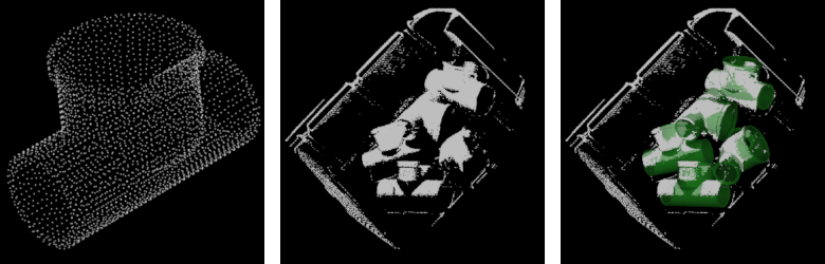
Along with the model and the scene, a number of parameters is regarded to set the proceedings of the matching algorithm. This way, the matching process can be adapted to the features and particularities of the object and the scene.
As a result, you receive the poses of your object, for example, its positions and orientations in the provided scene.
Surface-based matching methods🔗
- (Standard) Surface-based matching
-
Use case: Large and round shapes, extended in all three dimensions.
The standard surface-based matching using only 3D surface information should be employed in case you need to locate objects with large and round shapes extended in all three dimensions, for example when the 3D points representing an instance of the object in the scene do not all lie in one plane. This method should not be applied on objects with reduced 3D information, such as flat objects. A box viewed orthogonally from above appears as a flat object in the scene.
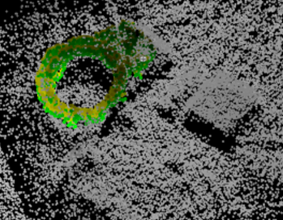
Figure 2: Surface data - Surface-based matching with 3D edge information
-
Use case: Shapes with reduced 3D information, that is, flat objects, boxes, objects that contain 3D information especially at edges and speed is in focus, or the 2D edges do not have an additional value.
In case speed is crucial, surface and 3D edge information should be used. This set of information can also be chosen in case 2D edge information has no positive but negative impact. This occurs for instance, when additional 2D edges from, for example, a bar code are present on the object.
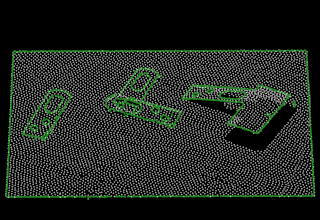
Figure 3: Surface data and 3D edge information (green) - Surface-based matching with 2D edge information
-
Use case: Shapes with reduced 3D information, that is, flat objects with 3D information especially at edges. However, the 3D data are noisy close to edges.
If point cloud information is too noisy to compute adequate 3D edges or in case the point cloud is not ordered, that is, no XYZ-mappings are available, surface information and 2D edges should be used.
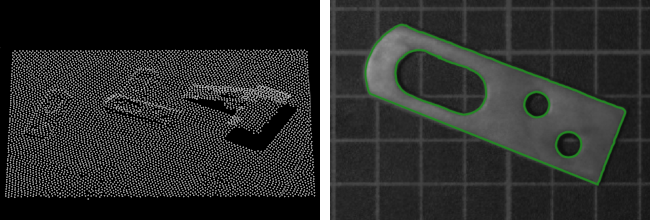
Figure 4: Surface data and 2D edge information (green) - Surface-based matching with 3D and 2D edge information
-
Use case: Shapes with reduced 3D information, that is, flat objects, boxes, or objects that contain 3D information especially at edges and accuracy is in focus.
When robustness and accuracy are crucial, both 3D and 2D edge information should be used as long as adequate edges can be extracted.
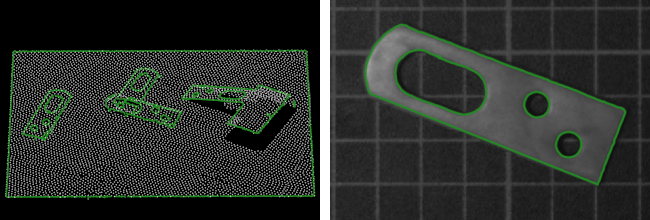
Figure 5: Surface data, 3D and 2D edge information (green)