3D shape-based matching🔗
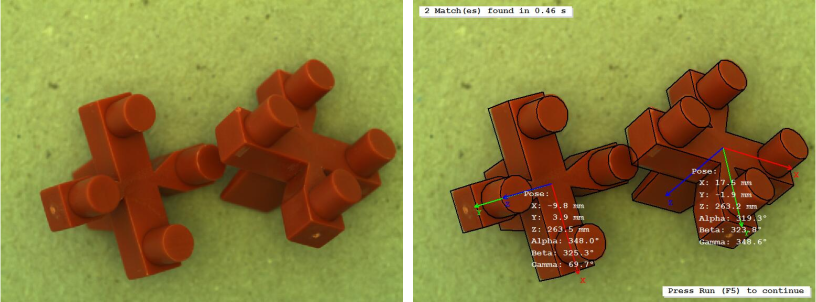
For the 3D pose estimation with shape-based 3D matching, a 3D shape model is generated from a 3D computer aided design (CAD) model. The 3D shape model consists of 2D projections of the 3D object seen from different views. To restrain the needed memory and runtime for the shape-based 3D matching, you should restrict the allowed pose range of the shape model and thus minimize the number of 2D projections that have to be computed and stored in the 3D shape model.
Analogously to the shape-based matching of 2D structures, the 3D shape model is used to recognize instances of the object in the image. But here, instead of a 2D position, orientation, and scaling, the 3D pose of each instance is returned.
If you need the 3D pose of a planar object or a planar object part, we recommend using the calibrated perspective deformable matching or the calibrated descriptor-based matching. Both are significantly faster, because no 2D projections of the model must be computed. Instead, a single 2D model is derived from images.