Tilt lenses and the Scheimpflug principle🔗
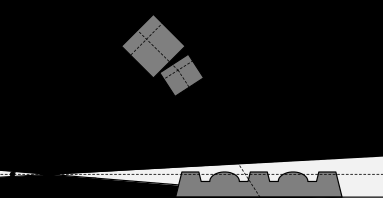
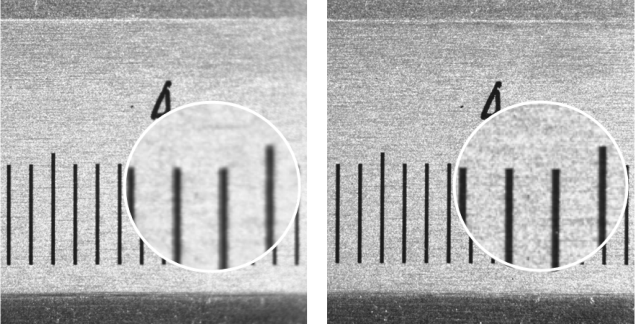
In a normal setup, the image plane is orthogonal to the optical axis of the lens (see Table 1). In case of strong magnification, that leads to the sometimes undesired effect, that objects that are viewed from an angle are partly out of focus, because of the limited depth of field (see Figure 1).
 |
 |
|---|---|
| Without tilt lens the focus plane \(F\) is parallel to the image plane \(I\).Therefore, the object is only partly in focus if it exceeds the depth of field \(d\). | When using a tilt lens, the focus plane, the image plane, and the lens plane \(L\) are intersecting in the Scheimpflug line \(S\). Using this principle, a planar object can be completely in focus even if it is viewed from an angle. |
To avoid this situation the lens or the image plane may be tilted to meet the Scheimpflug condition: The image plane, the lens plane, and the focus plane intersect in a single line, the Scheimpflug line. As a consequence, it is now possible to take images of objects that are completely in focus, even if they are not parallel to the camera.
The use of tilt lenses is especially useful if the depth-of-field is small, for example, due to a small field of view, a large magnification, or a low f-number. In these cases, it might be necessary to use a tilt lens to adjust the focus plane to better fit the observed scene.
This is typically the case in one of the following conditions:
- Physical Obstacles
- If the space directly above the object is blocked by obstacles, for example, some machine parts above the conveyor belt, the camera has to be mounted in a way that the objects can only be seen from an angle. Tilt lenses can be used to align the focus plane with the object plane.
- Stereo Vision
- In most stereo setups, the used cameras observe the scene at different angles. That means, when using normal lenses, their focal planes are also not parallel, that is, each camera covers a different volume that is in focus. With smaller depth-of-field or larger angle between the cameras, the volume that is in focus for all cameras gets smaller, what might lead to serious problems for the reconstruction. Tilt lenses can be used to align the focus planes of the different cameras.
- Sheet of Light
- In a sheet-of-light setup, a laser line is projected onto the scene, while a camera is observing the line’s reflection of the object. To get the most accurate results, it is desirable, that the focus plane of the camera is aligned with the sheet of light emitted by the laser. This is not always possible with normal lenses.
Note
If no tilt lens is available, in some applications it may be sufficient to increase the depth of field by using a higher f-number, that is, a smaller aperture. Of course that implies that either the exposure times have to be increased (which may lead to a longer overall cycle time) or a stronger illumination has to be used.